Reverse Osmosis vs. Carbon Filter at the Newport Beach Kitchen Sink
October 3, 2026
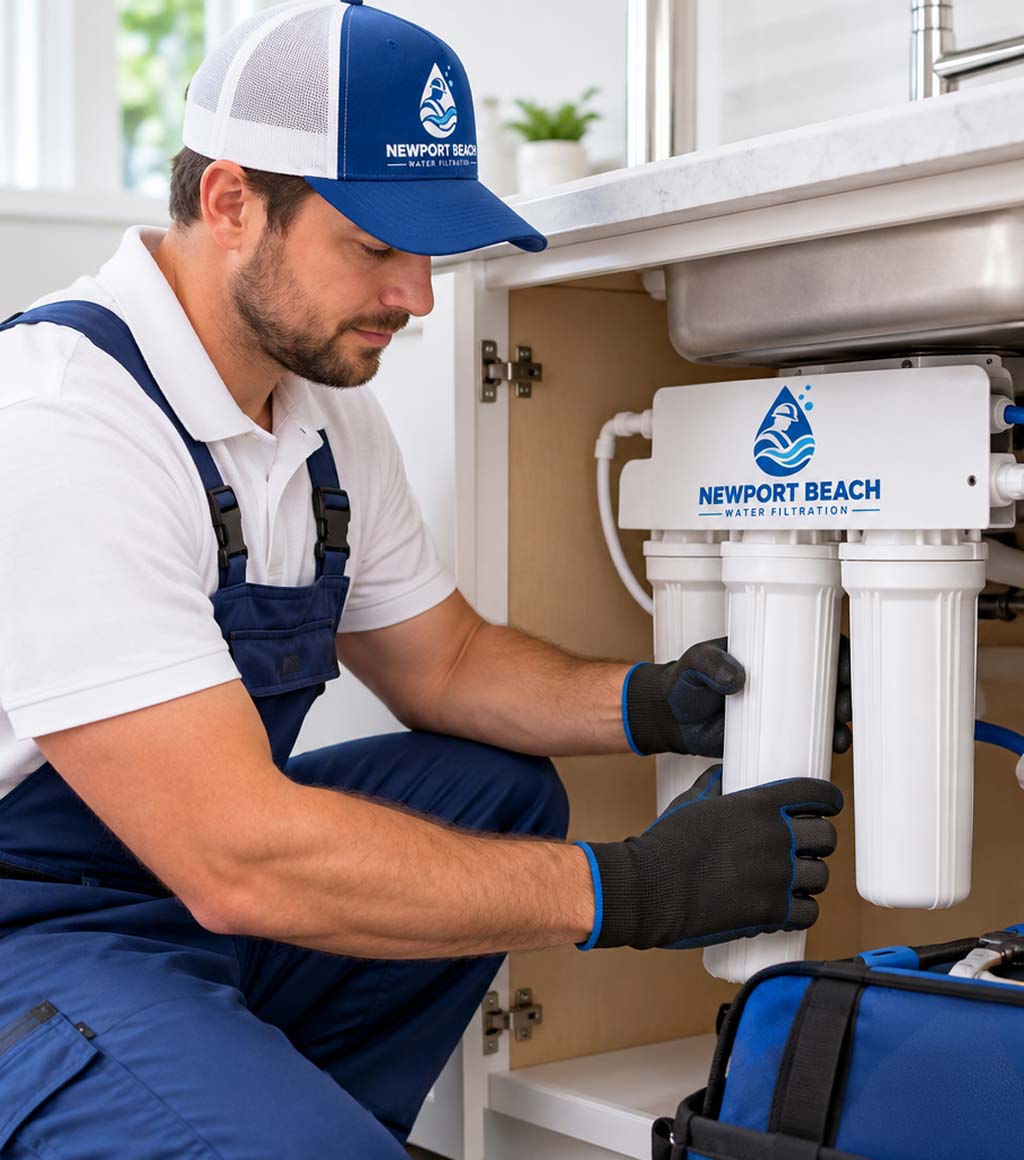
Two very different systems get quoted for the same cabinet under a Newport Beach kitchen sink, and they are not interchangeable. The reverse osmosis vs. carbon filter question comes down to what you dislike about the glass in front of you: a smell, a flat heavy taste, spots on the ice, a worry about something you read. Carbon holds certain substances on its surface as water goes by. Reverse osmosis strains out things dissolved in the water itself. Which of those jobs matters more at your address depends partly on whether the water in your pipes that month came mostly from wells in Fountain Valley or arrived down the Colorado Aqueduct. What follows looks at each system on its own terms, then sets them next to each other.
A Carbon Filter Works by Holding Contaminants on Its Surface
A carbon filter is a cartridge packed with activated carbon that water passes through, leaving certain contaminants stuck to the carbon while the water continues on. The Minnesota Department of Health describes the mechanism plainly: contaminants accumulate on the filter while water passes through. That adsorption process is good at a specific list, including chlorine, hydrogen sulfide, radon, trichloroethylene, trihalomethanes and other disinfection byproducts, and volatile organic compounds. Chloramine, the disinfectant Newport Beach uses, is also work for a carbon filtration system, though it needs more contact time and more carbon than free chlorine does, which is why a thin pitcher cartridge and a full-size under-sink block are not equivalent hardware. What carbon does not do is pull dissolved minerals out of solution. Calcium, magnesium, sodium, chloride and nitrate pass straight through, so water leaving a carbon cartridge carries the same mineral load it arrived with. Plumbing-wise it is the simpler animal: an inline cartridge on the cold supply, no storage tank, no drain connection, and essentially the flow rate you already have. Cartridges do saturate, and the same health department warns that bacteria can grow in a filter that is not replaced on schedule, so the maintenance is light but not optional.
Reverse Osmosis Pushes Water Through a Membrane and Leaves Dissolved Solids Behind
A reverse osmosis system uses household water pressure to push water through a semi-permeable membrane whose pores are small enough to reject most dissolved solids. The CDC notes that reverse osmosis filters remove germs and some types of chemicals, listing lead, copper, chromium, chloride and sodium, and adding that they may also reduce arsenic, fluoride, radium, sulfate, calcium, magnesium, potassium, nitrate and phosphorous. That list is the real difference: a roster of things dissolved in water rather than things that stick to carbon. A residential unit is rarely just a membrane. The usual stack is a sediment pre-filter, a carbon pre-filter protecting the membrane from chlorine and chloramine, the membrane itself, a small pressurized storage tank, and a carbon post-filter polishing the water on its way to a dedicated faucet. Carbon is therefore inside most reverse osmosis systems, which is worth knowing before the decision gets framed as one technology against the other. The membrane works slowly and continuously, filling the tank between uses, and sends a portion of the incoming water to the drain carrying the rejected minerals with it.
The Differences Show Up in Flow, Drain Water, Minerals and Service
Day to day, four practical differences separate the two: what each changes about the water, how much water goes down the drain, how fast the faucet runs, and what service looks like.
| Dimension | Carbon filter | Reverse osmosis |
|---|---|---|
| What it acts on | Substances that adsorb to carbon: chlorine and chloramine taste, disinfection byproducts, many organic compounds. | Dissolved solids: sodium, chloride, nitrate, fluoride, calcium, magnesium, plus the organics handled by its carbon stages. |
| Effect on dissolved solids | Little to none; water leaves with the mineral content it arrived with. | A large reduction, which is the entire point of the membrane. |
| Water sent to the drain | None. | Some rejected water on every production cycle; the ratio varies by unit and by water conditions. |
| Flow and hardware | Inline cartridge at normal cold-line flow, no tank, no drain line. | Slow production into a storage tank, a separate faucet, a drain connection. |
| Service | Cartridge swaps on a published schedule. | Pre-filters and post-filters yearly-ish; the membrane on a longer cycle. |
The drain-water line is the one Orange County households react to, and the same Minnesota fact sheet is blunt that reverse osmosis can create a lot of wastewater. Newer units are more efficient than older ones, but the water still goes somewhere. The flow difference is the other one people feel: filling a stockpot from a reverse osmosis faucet takes patience, while a carbon cartridge hands back something close to normal pressure. Cabinet space matters too, since the tank needs somewhere to live alongside the disposal and the trash pull-out.
Not sure whether taste or dissolved minerals is your real problem? An on-site water test answers it before you buy anything.
Get a Water TestNewport Beach Water Is a Blend, and the Blend Decides Which Difference Matters
Newport Beach does not have one water, it has a blend, and the ratio moves through the year. The City of Newport Beach 2025 Water Quality Report describes a supply that is about 80 percent groundwater, pumped from four wells in Fountain Valley and managed by the Orange County Water District, with the remaining 20 percent imported surface water from the Colorado Aqueduct and sometimes from Northern California's State Water Project. The two sources are not the same water. The report puts average total dissolved solids at 357 parts per million for groundwater and 621 parts per million for the imported supply, with average hardness of 13 and 16 grains per gallon respectively. Hold those numbers next to the federal benchmark. The EPA sets a secondary standard of 500 milligrams per liter for total dissolved solids, and is explicit that secondary standards are guidelines for aesthetic considerations such as taste, color and odor rather than health limits. Local groundwater sits under that guideline on average; the imported supply averages above it. That gap is a reasonable explanation for a complaint heard in kitchens from Balboa Island to Newport Coast, that the water tastes heavier some stretches than others. A carbon cartridge will not move that number. A membrane will. Both sources are disinfected with chloramines, which is squarely carbon's job.
Remineralization Is the Trade-Off Buyers Notice After Installation
Reverse osmosis takes calcium and magnesium out along with everything else dissolved, and the taste of the result surprises some households. Water with very little mineral content reads as clean and slightly flat, and people who liked the body of their tap water sometimes do not like what comes out of the new faucet. The common answer is a remineralization cartridge installed after the membrane, which adds a small, controlled amount of mineral back for taste. It does not restore hardness to the house, and it is a flavor adjustment rather than a nutritional one, since drinking water is only one of several places a diet picks up minerals. Carbon takes the opposite approach by default: the mineral profile goes through untouched, so the water still tastes like Newport Beach water, minus the chloramine edge. For a household whose only complaint is the pool smell on a warm afternoon, that is exactly right. For one that describes the water as heavy or salty during imported-supply months, leaving the minerals in place leaves the complaint in place.
When Each One Is the Right Call
Choose by the complaint you actually want solved. A carbon filter fits when the problem is smell or taste tied to disinfection, when the water already tests under the aesthetic guideline, when you want normal flow for cooking, when cabinet space is tight, or when you rent and want something reversible with no drain tap. Plenty of homes in Corona del Mar and Eastbluff land here, because a well-sized under-sink drinking water filter answers the whole complaint for less money and less fuss. A reverse osmosis system fits when the dissolved load is the problem: a high total dissolved solids reading, a household watching sodium, clear ice and better espresso, or an appliance like a steam oven or aquarium that wants low-mineral water. The two also coexist. A whole-house carbon filter handling chloramine at every tap with a reverse osmosis unit at the kitchen sink is a common arrangement, and neither addresses scale on the water heater, which belongs to a softener instead.
Start With the Complaint, Not the Catalog
Write down the specific thing you dislike before you open a single product page, because the complaint points at the technology faster than any spec sheet does. Then get a reading at your own tap, ideally during a stretch when imported supply is in the mix, since the number that settles this question moves with the blend. A pool smell with dissolved solids under the aesthetic guideline is a carbon problem on a carbon budget. A heavy or salty taste with a high reading will not improve no matter how good the cartridge is. The measurement decides it, not the brochure.
When you would rather have that number read at your sink than guessed at, Newport Beach Water Filtration tests on site and sizes either path to what the test shows, whether that turns out to be a carbon filtration system or a reverse osmosis system. Both fit the same cabinet, and knowing which one you need beforehand is the part that saves money.
Related Services
Compare reverse osmosis systems, carbon filtration systems and under-sink drinking water filters in Newport Beach, or head back to the Newport Beach Water Filtration home page.
Ready for Clean Water at Every Tap?
Find out what your water needs with an on-site test, then get a flat-rate quote with no obligation.
Licensed, bonded & insured · NSF/ANSI-certified systems · Satisfaction guaranteed